Showing posts with label Tip. Show all posts

Friday, December 12, 2008

To center or not to center, that is the question...


For this post I've taken the same picture posted it twice, the first is the original and the second is a cropped version of the same picture. This is to show the idea of positioning your subject in the picture. The first picture is ok, but the second picture is better because it follows a design rule called the rule of thirds. More over it follows it twice. I recently read a few chapters of a book (someday I'll finish it) which talked about where to put your subjects in a picture. The design rule of thirds says that things are more intersting and can convey information differently by moving subjects off the center. The book stated that one thing that you want to do when possible is put something at the cross of one of the thirds across and one of the thirds vertically. When taking pictures of people try to put the eyes of your subject and one and where posible an intersection of both thirds. this will draw a viewers attention and cause them to look at your picture for longer....which is a good thing. I'm trying to show that idea above using the fluffy bunny.

The settings:
Camera: Canon EOS 40D
Lens: Canon EF 28-135mm f/3.5-5.6 IS
Exposure: 0.02 sec (1/50)
Aperture: f/5.6
Focal Length: 135 mm
ISO Speed: 640

About the Lens setting:

Lens: Canon EF 28-135mm f/3.5-5.6 IS

First is the brand - useful if you like how the lens does and you want to find it.

Next is EF - This is what kind of camera can use this lens, if your camera can use cannon ef lenses then this one would work on it.

Then there is the 28-135mm - I don't know a great way to explain what I understand this to mean other than to realate it to a fixed lens 35mm film camera that most people have used at some point in there lives. It also affects how big the subject looks in your picture....or zoom. This is a mid range lens, I know this because I know that a 35mm camera works well at mid range, it can do ok close up or far away from your subject, but is best halfway in between. The zoom allows more flexability to how close I need to be to my subject to how much of the picture I want them to take up.

f/3.5-5.6 - This is the focal range or how much behind or infront of your subject that is in focus when your subject is in focus. Lower numbers mean less is in focus, this can give you the really nice blurs you see a lot in my pictures. Also to note is that the lower focal point needs less light since a smaller portion of the picture needs to be in focus. This is one of the reasons that fixed focal length lenses more more expensive, they are more flexable. A lens with a fixed focal length doesn't mean you can't set the number higher for taking pictures where your subject takes up most of the picture or landscape type photo's. With my lens the focal length minimum goes up as you zoom in taking away the flexability of how close to my subject I have to be. This is especually true in lower light. The range (28-135mm) and focal length of a lens are the two biggest factors when buying most lenses, though this may not be the case for specialty lenses.

The last bit about this lens is the IS - IS stands for image stablization. With this lens, being at mid range and having a variable focal range the image stablization is extreamly nice to have. It makes a huge difference as to weither I can hold the camera still enough in less than ideal conditions in order to get the shot. IS seems to be less important on shorter range lenses since you are closer to your subject anyway and more important with longer range lenses. I certainly don't want to carry a tripod with me everywhere I go.

Thursday, December 11, 2008

Introductions...

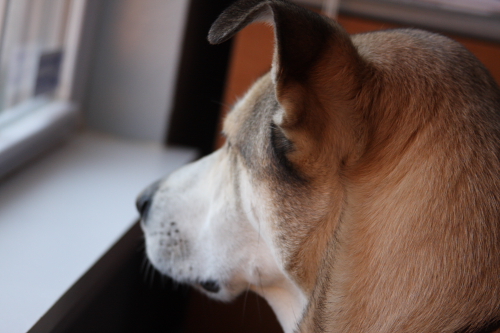
This is my dog. Although this is the first time you've seen him here he is the subject of a TON of my pictures. There are two things that make this a nice shot. The first is the positioning. He as ths subject isn't just centered looking at the camera. It looks like something is going on in the photo and a moment was captured. The other thing is that I got down close to his level to take the picture. It doesn't seem like much, but try it. Take a photo from standing over a smaller subject, then take the same picture from it's level or slightly higher if you want to see depth behind the subject. You'll definatly see a difference.

Settings:
Camera: Canon EOS 40D
Lens: Canon EF 28-135mm f/3.5-5.6 IS
Exposure: 0.04 sec (1/25)
Aperture: f/5
Focal Length: 80 mm
ISO Speed: 640

You might wonder why I'm putting the camera settings on all of my posts here. Well two reasons, the first of which is that I'm still pretty new at taking pictures and I've found when asking professionals that they can look at the picture and give me feedback on the problems with light and such, but when I can show them settings with it the feedback is much more detailed. So the settings are there for any visitors that want to give feedback such as, "hey that's a pretty good photo, but if you set your settings to this it could have a pretty cool effect in that situation.

The second reason for the settings is to help others that are trying to learn to take pictures. Hopefully as more pictures go up it will be easier to see how the settings affected the picture so others might get a better idea of what to try if they are having problems.

For this post I'll talk about the Camera Setting:

Camera - ya that's the hardware being used to take the picture, not a big deal buf if your thinking of getting a new camera and you want to see some sample images from this camera....here you go. I really like my camera and I think it's a great mix of highend/lowend.

Like I said I'm new at this so going and spending money on the top of the line camera would be great if I had it, but this camera has the software of the highest end Cannon cameras so it does a fantastic job of rendering the digital image quickly and well. It has a smaller sensor inside the camera than the highest end cameras. That means it will take nice pictures but the higher end cameras have an advantage to getting a sharp picture, especually in less than ideal conditions, but it makes this camera much less expensive yet still really nice. Another thing I like about this camera is that all the lenses and extra bits I get to help me take a nice picture will work on higher and lowerend cannon cameras so I only have to make the investment once and I can upgrade or downgrade cameras later if I find I'm getting more or less into photography. Nikon have the same thing, I just chose Cannon because at the time this model was new and better than it's equvilent price range Nikon counterpart.

Wednesday, December 10, 2008

Another play with light


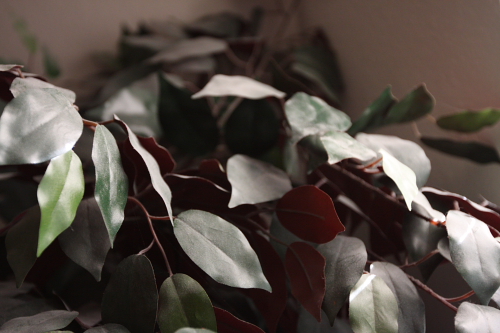
Here is a photo that combines two things that I think make taking an interesting photo easy. One is getting close to the subject. The macro type shot normally makes a nice looking picture even if it is of a dusty fake plant. The second thing that adds to this photo in my opinion is the way the light is coming in from the side. Books talk about it alot for portrait style photo's to help set a mood, but it works equally well for objects.
The settings:
Camera: Canon EOS 40D
Lens: EF16-35mm f/2.8L II USM
Exposure: 0.006 sec (1/160)
Aperture: f/2.8
Focal Length: 35 mm
ISO Speed: 800

Sunday, December 7, 2008

All aboard


While playing a game of Railroad Tycoon a friend asked if I could get a picture he could use as an icon. I really like the way this turned out. By lowering the camera to just above the level of the game it really gave a feeling of an endless expanse of gaming goodness.


Here are the stats:
Camera: Canon EOS 40D
Lens: Canon EF 28-135mm f/3.5-5.6 IS
Exposure: 0.025 sec (1/40)
Aperture: f/4
Focal Length: 44 mm
ISO Speed: 800